

Hockey Pool Guide
Hockey pool rules for friends and office groups in Canada: scoring, draft steps, prize split and common mistakes, plus where Spin Palace Casino fits.
- AGCC licence 155 C1
- Deposits from C$10
- 1,700+ games
The short answer. A hockey pool is a friendly game where each entrant drafts NHL players, earns points for their goals and assists, and the top totals share the pot. Agree the rules, the buy-in and the prize split in writing before the draft. Spin Palace Casino does not run hockey pools, so this guide covers the office and friends version.
How hockey pools work in Canada
Across Canada the hockey pool is a seasonal tradition among coworkers, friends and family. It usually follows the NHL regular season from October to April, with a separate playoff pool after that. Each entrant drafts a team of skaters and goalies, then scores points from what those real players do on the ice. Nobody plays against a house. Entrants put in a small buy-in, a volunteer organizer keeps the scores, and the top finishers share the pot.
- Season
- October to April
- Playoff pool
- Starts with round one
- Typical buy-in
- C$10-C$50
- Roster size
- 10-20 players
- Scoring
- Goals and assists
- Draft
- Before opening week
Spin Palace Casino does not host hockey pools and has no pool product, because a pool is a social game among people who know each other. If you want something to play on a quiet evening during the season, the slots and lottery sections are the place to look. Keep the two separate: the pool has its own rules that your group writes, while casino play has its own terms, and the minimum age depends on your province. Players in Ontario can also read why there are no promo codes in Ontario.
Games Global
12 Masks of Fire Drum Frenzy, 1st Class Express Big Train Bonus, 3 Lucky Rainbows Action Boost SpinUp
Pragmatic Play
The Bingo Spot, Gameshow Party Jackpot Play, 3 Magic Eggs
Evolution
Red Baron Live, Red Baron RNG, American Roulette by Evolution
Common hockey pool mistakes
Most pools that fall apart do so for the same few reasons, and almost none of them have anything to do with hockey. The trouble starts in March, when two people read the same rule in different ways and the group chat goes quiet. A little time spent on the rules in September saves all of that.
Vague scoring
A rule like points count leaves people arguing in April. Write down what a goal, an assist and a goalie win are worth before the draft.
Late entries
Letting someone join after week one gives them hindsight on who is hot. Set a fixed entry deadline and a date when the buy-in is due.
Injured stars
Decide in advance what happens when a player is hurt or traded. A simple replacement window avoids long message threads.
No tiebreaker
Two teams finishing level on the last day is common. Pick the tiebreaker, such as most goals, before the season starts.
Organizer fees
Pools stay friendly when the whole pot goes back to the entrants. Skimming a fee, even a small one, changes the mood fast.
Cash chaos
Collect buy-ins up front and keep a simple ledger of who has paid. Chasing C$20 in March is nobody's idea of fun.
Running a pool step by step
You do not need special software to run a good pool. A shared spreadsheet, a group chat and one person willing to update the numbers every week are enough. The steps below follow the order most organizers use, from the first message to the final payout.
Write the rules
Put roster size, positions, scoring and trade rules on one page. Share it before anyone pays.
Fix the buy-in
Choose an amount everyone is comfortable with, for example C$20, and a clear payment deadline.
Close the entries
Stop taking entries on a set date, normally before opening week, and keep a list of who has paid.
Run the draft
Use snake order, so the last pick of round one picks first in round two. Draft in person or in a group chat.
Track the scores
Update one shared sheet each week, adding goals and assists from the official NHL stats.
Handle changes
Open a short trade or replacement window, for example once a month. Outside it, rosters stay locked.
Pay the winners
After the last regular season game, check the totals, apply the tiebreaker and pay out as agreed.
| Event | Points |
|---|---|
| Goal | 1 |
| Assist | 1 |
| Goalie win | 2 |
| Shutout | 2 |
| Overtime goal | 2 |
Swipe the table sideways to see every column.
This is one simple scoring sheet that many groups use. Goals and assists keep the maths easy, and the extra points for goalies stop everyone from ignoring the crease. Some pools give a bonus for overtime goals, others drop it to keep tracking light. Pick the version your group will actually keep up with all season.
Splitting the pot
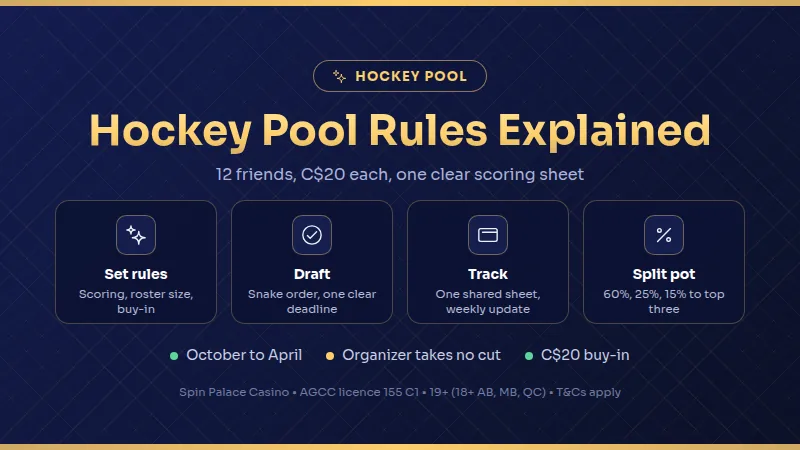
Say 12 people each put in C$20. That makes a C$240 pot. A common split pays 60% to first place, 25% to second and 15% to third, which comes to C$144, C$60 and C$36. Smaller pools often pay only the top two, and larger ones may add a small prize for last place. Whatever you choose, write the split into the rules before the draft so nobody has to guess.
12 entries at C$20 each, split 60%, 25% and 15%.
What pool players say
Organizers who run a pool year after year tend to say the same thing: the simplest rules last longest. Entrants like a clear scoring sheet and a draft night that doubles as a social event. Many say the best part is the daily chatter over who is hot and who got lucky with a late pick. People who tried a complicated setup often go back to plain goals and assists in the following season.
Strengths
- Draft night is a social event for the whole group
- Simple scoring is easy to follow all season
- A small buy-in keeps the mood relaxed
- The weekly standings give everyone something to talk about
Worth knowing
- The sheet needs a weekly update from the organizer
- Trade windows work best when someone keeps an eye on them
Pool habits: before and after
| Before | After |
|---|---|
| Loose rules | Written rules |
| Cash in envelope | Written ledger |
| Paper tally | Shared sheet |
| Open entries | Fixed deadline |
| Ties argued | Tiebreaker set |
| Trades by chat | Monthly window |
Swipe the table sideways to see every column.
Almost every change in the right-hand column costs a few minutes in September and saves hours in April. A written rule page is the biggest single improvement, because it turns an argument into a quick look-up. A shared sheet comes second, since everyone can check their own points and the organizer stops answering the same question every Monday.
Rules page written and shared with every entrant
Buy-in amount and payment deadline agreed
Prize split written down, with the tiebreaker
Entry deadline set before the season opens
Draft order and format confirmed
Trade or replacement window dates listed
One person named to update the standings weekly
A pool is meant to be a friendly game. If money ever starts to feel like pressure, free and confidential support is available from ConnexOntario and responsiblegambling.org.
Hockey pool questions
Does Spin Palace Casino run a hockey pool?
No. Hockey pools are informal games between friends, family and coworkers, and the casino has no pool product. If you want to play on the site during the season, take a look at the slots and lottery sections, which work under their own rules.
What are the basic hockey pool rules?
Each entrant drafts a roster of NHL players, and points come from their goals, assists and goalie results. The top totals at the end of the season share the pot. Beyond that, the group decides roster size, scoring values, trade rules and the prize split, and it writes them down before the draft.
How much should the buy-in be?
Most groups choose something between C$10 and C$50, an amount nobody minds losing. Smaller buy-ins keep the pool relaxed and make it easier to get everyone in. Collect the money before the draft and note who has paid, so the final payout is quick and clear.
When does a hockey pool start and end?
A season-long pool usually runs from October to April alongside the NHL regular season. Many groups start a fresh playoff pool when round one begins, with a new draft and a smaller buy-in. Settle the end date in your rules, for example the last regular season game.
What is the best way to settle ties?
Choose the tiebreaker before the season starts. Common options are most goals, most goalie wins or the better finish in the final month. If you want the simplest answer, split the prize between tied teams. Whatever you pick, put it on the rules page so it never becomes a debate.
Do I need a casino account to join an office pool?
No. An office pool needs only the organizer's sheet and your buy-in. A casino account is a separate thing, and the minimum age depends on your province. If you decide to try the casino too, the sign-up page shows how it works.
Where can I get help if gambling stops being fun?
Free, confidential support is available from ConnexOntario and responsiblegambling.org. If you also play at an online casino, remember that a credit card deposit counts as a cash advance, so keep an eye on what you spend and stop whenever it no longer feels like a game.
Start with the Spin Palace welcome match
Open an account, deposit C$10 or more and get a 100% match up to C$100, plus 10 daily spins on the Mega Millionaire Wheel.
- AGCC licence 155 C1
- Deposits from C$10
- Withdrawals in 1-7 Days
- 1,700+ Games